Openers · Keelesdale
Garage Door Opener Diagnosis and Repair in Keelesdale
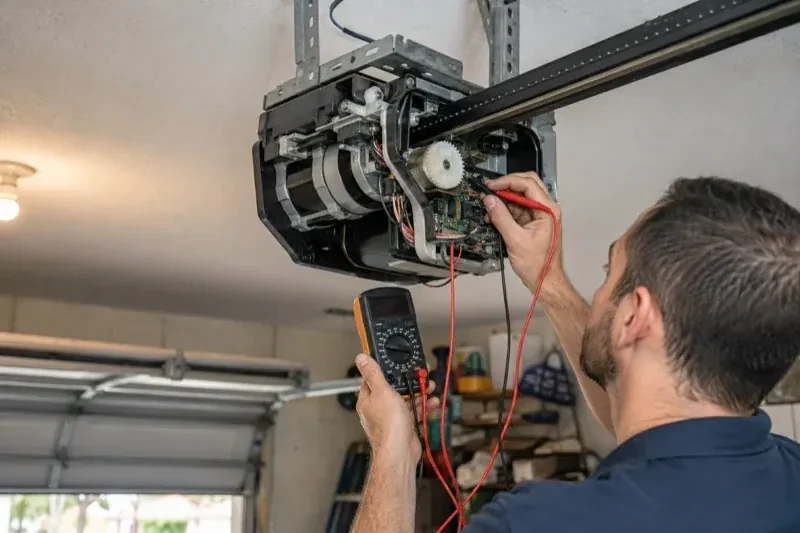
The motor runs, the chain rattles along the rail, and the door does not move a millimetre. You notice the little carriage sliding back and forth on its own.
Garage Door Opener Diagnosis and Repair
In plain words
Every diagnosis ends with the same two tests, because an opener that moves the door is only half fixed. First, a length of 2x4 is laid flat on the floor under the centre of the door and the door is closed onto it; it must reverse on contact and return to fully open. Second, with the door closing, an object is passed through the photo-eye beam near the floor; the door must stop and reverse. These tests are how the opener standard defines a working unit, and they are how the technician proves that the fault found was the fault fixed.
How the visit goesThe wall button works every time. The remote only works if you are practically under the door; from the end of the driveway it does nothing at all. It started around the time you changed the bulbs in the opener to LEDs.
Keelesdale
How the visit goes
The door by itself
With the door fully closed, the technician pulls the emergency release and lifts the door by hand. A healthy door rises smoothly with modest effort, holds still about a metre off the floor, and stays up when fully open. If it is heavy, drifts down, or stays put only at the top, the springs are tired or broken and the opener has been doing work it was never sized for. Tracks, rollers, hinges, cables and drums are looked over at the same time. This check comes before any powered testing, because a door in this state is corrected on the door side first, by someone with the tools for tensioned hardware.
Restoring power the right way
When the fault is electrical supply, the fix is matched to the cause rather than simply reset. A tripped breaker or ground-fault device is reset and then watched through several cycles to be sure it holds; one that trips again points to a damaged cord, a wet outlet or a failing motor. A blown board fuse or a dead transformer is replaced with the part specified for the model. Surge damage after lightning often shows as a board that lights up but ignores every control, and that board is replaced where the model is still supported. New receptacles or hard wiring are referred to an electrical contractor.
The monthly test you can do yourself
You leave knowing a short check that catches most opener trouble early. Once a month, with the door open, lay a piece of 2x4 flat on the floor under the middle of the door and press close; the door should touch it and go straight back up. Then close the door again and pass a broom handle through the sensor beam near the floor; the door should stop and reverse. Watch the sensor lights stay steady. If either test fails, stop using the opener and book a visit. These are the same tests the technician just performed, and they are all the standard asks of a working unit.
Garage Door Opener Diagnosis and Repair
In the van
- Start capacitor
- Trolley and carriage
- Photo-eye sensor pair
- Transformer and board fuse
- Wall control
What affects the quote
Same fees day, night or weekend
1Getting in when the door is stuck shut
A garage with no side door and no house connection means working the release from outside before any test can begin, and the quote includes that entry step.
2Ceiling height and access
A standard-height garage puts the head unit in easy ladder reach. High ceilings, high-lift tracks, storage lofts or a car that cannot be moved add setup time and sometimes a taller ladder.
3Season and weather
A frozen seal, a stiff door and an unheated garage in the cold months add steps to a diagnosis, such as freeing the door and re-lubricating for low temperatures, and the quote allows for them.
Garage Door Opener Diagnosis and Repair: questions
The door is stuck shut and my car is inside. How do you get in?
Through the house if the garage connects to it, or through a side door. Many doors also have an outside keyed emergency release, a small keyed cylinder that pulls the trolley free so the door lifts by hand from outside. If yours does not have one, the technician can fit a keyed release kit as part of the visit so there is a safe way in next time; until then, an alternate entrance is used and the diagnosis proceeds once inside.
The motor hums but the door stays put. What is usually wrong?
A hum with no movement means the motor is receiving power but something is stopping it turning, or stopping its turn from reaching the door. On AC units a failed start capacitor is the common cause; on chain-drive heads a stripped nylon drive gear is the other. Less often the trolley has simply been released from the carriage. Each of these is a routine repair once identified, and the hum is one of the more helpful sounds an opener makes.
Can the force just be turned up so the door closes in winter?
Raising force is not the fix; it only hides one. The force setting is the opener's sense of touch, and turning it up so a door pushes through a frozen seal or stiff rollers also means it pushes harder against anything else in its path. The right approach is to free the seal, lubricate the moving parts for cold weather, confirm the balance, and then set force as low as reliably works, proving it with the 2x4 test.
Openers & Access
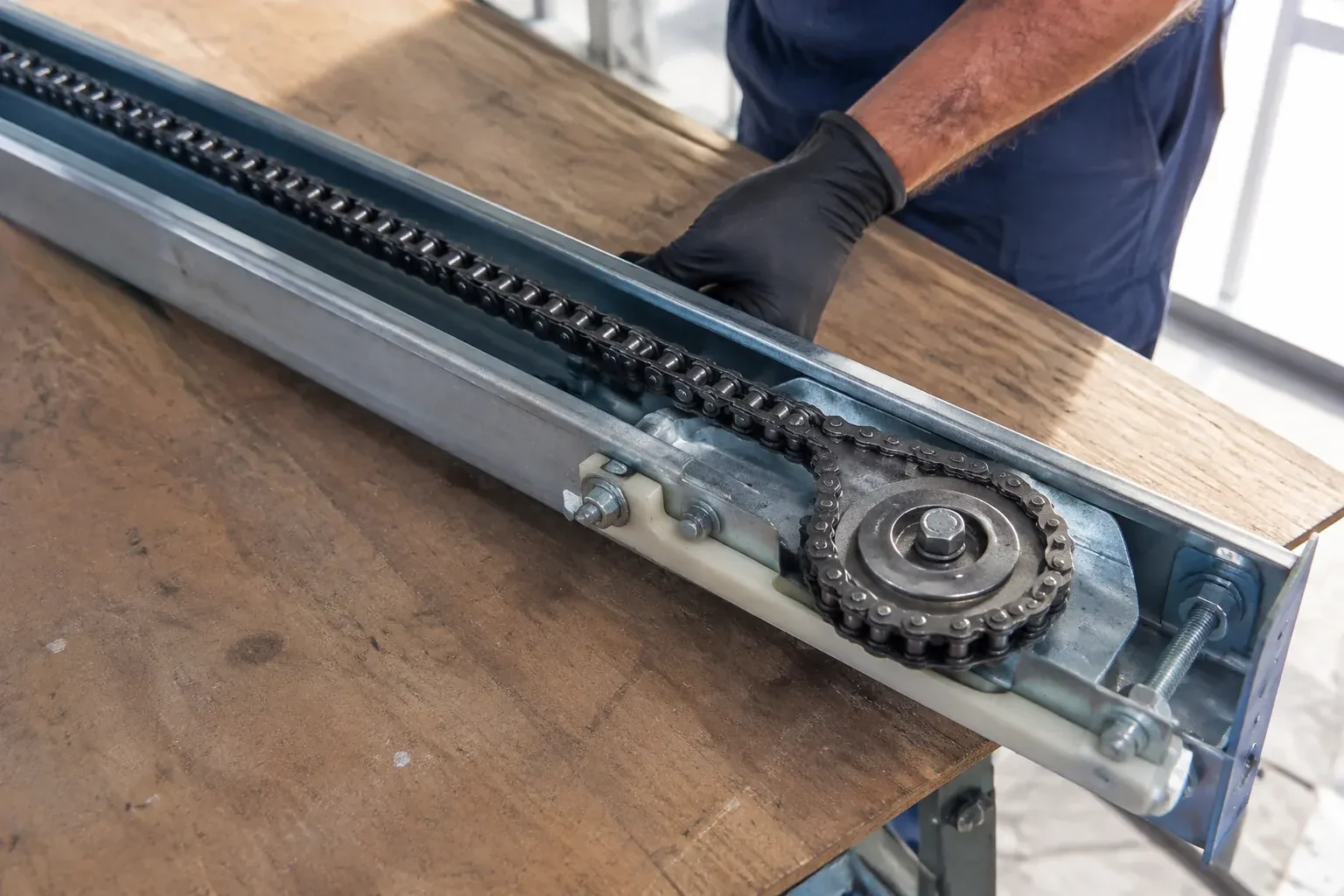
- Belt-Drive Opener RepairThe door used to glide up with a soft hum.
- Garage Door Opener ReplacementSince the storm the door behaves oddly: it reverses halfway down for no reason, the light flickers…
- Photo-Eye Sensor Alignment or ReplacementSomeone backed the car in a little too far, a bin or a bicycle brushed the track, and since then…
Garage Door Opener Diagnosis and Repair near you
For homes and businesses in Keelesdale we handle the full run of garage door work: broken springs and cables, doors that have left the track, openers and remotes that stopped answering, worn rollers and seals, tune-ups, and new doors chosen and installed to suit the building.